
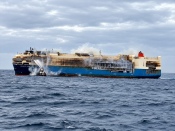
Increasing numbers of lithium batteries are crossing the oceans inside cars, electronic equipment and energy storage systems. Their expansion is changing the risk profile of a maritime industry that must transport larger volumes of cargo whose characteristics can complicate the response to a fire.
The main challenge arises when a damaged, defective or overheated battery enters a process known as thermal runaway. In this process, temperatures rise uncontrollably in a self-sustaining reaction that can spread between cells and release flammable and toxic gases, as well as trigger new fires after the initial flames have been brought under control.
This scenario is particularly relevant to car carriers, where thousands of vehicles may be transported on enclosed decks with limited space between them. During a fire, gaining direct access to its source can be difficult, while the response must also prevent the flames from spreading to other vehicles.
The European Maritime Safety Agency (EMSA) has identified thermal runaway, gas generation and the potential for reignition among the factors that must be considered when designing detection and response procedures for these vessels.
Regulation seeks to keep pace with change
The growth of these cargoes is also driving updates to international regulations.
Amendment 42-24 to the International Maritime Dangerous Goods (IMDG) Code became mandatory on January 1, 2026, introducing new classification entries specifically for battery-powered vehicles. These include UN 3556 for vehicles powered by lithium-ion batteries, UN 3557 for those equipped with lithium metal batteries and UN 3558 for vehicles powered by sodium-ion batteries.
The next revision is already on its way. Amendment 43-26, adopted by the International Maritime Organization’s (IMO) Maritime Safety Committee in May 2026, introduces new criteria for batteries and electric vehicles, including special provision SP 980, intended to assess a vehicle’s safety condition before it is offered for transport.
The amendment may be applied voluntarily from January 2027 and will become mandatory in January 2028.
Meanwhile, the IMO continues to work on vessel design and onboard response systems. In March 2026, its Sub-Committee on Ship Systems and Equipment identified priority measures to reduce fire risks on ships carrying new energy vehicles, including electric vehicles, with a view to establishing new mandatory provisions by 2032.
The discussion extends beyond car carriers. In the container ship segment, the organization finalized draft amendments to SOLAS during 2026 that include portable infrared thermal imaging cameras and water mist lances as additional tools for fire detection and firefighting.
Fires reveal the severity of the risks
Regulatory concerns have also been fueled by a series of casualties that exposed the difficulties of tackling fires on ships carrying electric vehicles.
In February 2022, the “Felicity Ace” caught fire in the Atlantic while carrying 3,965 vehicles and subsequently sank. According to information reviewed by EMSA, the crew reported that the fire had started in an electric vehicle, although the cause of the casualty could not be conclusively established.
A year later, the fire aboard the “Fremantle Highway” once again brought this type of cargo into focus. The vessel was carrying 3,784 vehicles, including 498 electric vehicles. In this case, the Panama Maritime Authority’s investigation concluded that the evidence indicated the ignition source was an electric vehicle located within a block of 24 such vehicles on deck 8.
In 2025, the “Morning Midas” added another case. The car carrier was transporting 3,048 vehicles, including 70 electric vehicles and 681 hybrids, when it caught fire in the North Pacific. After drifting at sea, it eventually sank on June 23. However, the exact cause of the fire remained undetermined in the information reviewed by EMSA.
The three incidents illustrate an important distinction: the presence of electric vehicles aboard a ship is not, by itself, sufficient to establish the origin of a fire. While the investigation into the “Fremantle Highway” identified an electric vehicle as the ignition source, the causal link remains unresolved in other cases.
When the risk travels inside a container
Beyond car carriers, batteries are also transported as dangerous goods in containers, where the problem begins even before the cargo reaches the ship.
Proper declaration, documentation, packaging and stowage are essential to ensure that the shipping line and crew know what they are carrying and where it is located aboard the vessel. An incorrect declaration can result in a container being placed in an unsuitable stowage position and hinder the response during an emergency.
According to reports cited by Allianz Commercial, “around a quarter of cargo-related incidents are associated with misdeclared cargo,” including batteries and chemicals.
The problem was also illustrated by the “Genius Star XI.” In December 2023, the vessel was carrying lithium-ion battery energy storage systems when it encountered adverse weather in the North Pacific.
The National Transportation Safety Board (NTSB) investigation determined that 41 of these systems broke free from their lashings and shifted inside the cargo holds. The deformation sustained by some of them caused batteries in three units to enter thermal runaway, triggering two fires. Damage was estimated at US$3.8 million.
Unlike other casualties, this case allowed investigators to establish directly the sequence that led from cargo movement and damage to the outbreak of fire.
More batteries, but not necessarily more fires
The growth of these technologies coincides with a period in which onboard fires and explosions have remained at elevated levels.
A total of 250 incidents were recorded in 2024, the highest figure in the past decade. In 2025, the total fell to 218, although it remained the second-highest figure over that period. Meanwhile, global lithium-ion battery deployment in 2025 was six times higher than five years earlier.
Both trends are occurring simultaneously, but the available data do not establish that one is a direct consequence of the other. The increase in batteries transported expands the industry’s exposure to this type of cargo, but does not, by itself, demonstrate that they are responsible for the overall rise in maritime fires.
What the investigated incidents do show is that, when a battery enters thermal runaway or is damaged during transport, the characteristics of the fire may require procedures and systems that differ from those traditionally used.
By MundoMaritimo
3722 registered companies, 51 countries, 85 sponsored companies
Customs Agents
Shipping Agencies
Storage and Warehousing
Shipyards
Shipping Companies
Marine Consultants and Surveyors
Cargo Agents
Port Companies & Terminals
Nautical Equipment
Loading and Unloading Agencies
Exporters
Importers
Engineering, Certifications, Surveyors
Organizations
Other related Activities
Fishing Companies
Spare Parts
Puertos Terrestres, Zonas Extraportuarias
Air Transportation
Overland Transport
Tourism
La política que en el presente documento se indica, tiene por objeto informar a los usuarios de MundoMaritimo sobre el proceder de nuestra empresa respecto del tratamiento de los datos de carácter personal recogidos a través de nuestros portales.
1 | Recolección:Cuando Usted requiere los servicios de MundoMaritimo, se recoge información personal como su nombre, rut, dirección, etc, a través de correo electrónico o formularios. Nuestro sitio no utiliza actualmente cookies, para registrar o recabar información del usuario, pero, podrá en cualquier momento y a su sola discreción y sin necesidad de autorización, utilizarlas, comprometiéndose dar el tratamiento y protección señalado precedentemente a dichos datos.
Para qué se utiliza la información recolectada.Toda la información recolectada de los usuarios en MundoMaritimo tiene por objetivo:
(1) Brindar servicios, contenidos y publicidad personalizada al usuario en su navegación por los portales de MundoMaritimo
(2) Realizar estudios internos sobre los datos demográficos, intereses y comportamiento de nuestros usuarios. La información se utiliza para entender y servir mejor a nuestros usuarios.
2. Uso:Estos datos que usted proporciona libre y voluntariamente, tienen por objeto dar un mejor servicio, información y utilidades a nuestros usuarios. Usted tiene el derecho de no aceptar entregarlos, renunciando a los beneficios que nuestro sitio web entrega.
Si decide aportar dichos datos, nos obligamos con usted a mantener una conducta clara y regular, sometida a la política que a continuación expresamos, de la cual usted es informado y que acepta.
Nuestra política respecto de los datos recogidos es la siguiente:
La responsabilidad por la veracidad de los datos recogidos por esta vía, es exclusiva del usuario.
3. Seguridad:Mantenemos una base de datos Off-Line, la que asegura a sus clientes total privacidad, respecto de los datos proporcionados a MundoMaritimo.
Por otra parte, una reconocida empresa externa proveedora de servicios de conectividad y hosting debidamente certificada, "aloja" nuestros sitios en sus servidores web, los 365 días del año, los siete días de la semana y las veinticuatro horas, lo que asegura que nuestro sitio tenga la menor posibilidad de "caída" en la web o intrusiones de "hackers" que vulneren nuestro Portal.
4. Calidad:Sin perjuicio de las responsabilidades que al usuario le corresponden, MundoMaritimo tendrá especial cuidado al recolectar, mantener, usar, publicar o distribuir la información personal vinculada a los usuarios y visitantes, verificando que los datos sean correctos, completos y adecuados para cumplir con los fines para los que serán utilizados.
5. Modificación:El usuario que haya entregado previamente datos o información personal a MundoMaritimo, podrá solicitar su modificación, corrección o eliminación, enviando un correo electrónico a [email protected], indicando su nombre, rut, dirección, teléfono, y expresando claramente que información de la que hubiere entregado desea modificar o eliminar.
En todo caso, y como medida de seguridad, MundoMaritimo se reserva el derecho de verificar la autenticidad de la comunicación.
6. Publicación e intercambio:MundoMaritimo, como norma general, no transferirá, cederá, venderá o de otra manera proveerá sus datos de carácter personal a persona alguna. MundoMaritimo podría transferir, revelar o ceder los datos recopilados a sus usuarios, a terceros de acuerdo a las siguientes circunstancias:
(1) En caso de tener la aprobación explícita del usuario, sus datos de carácter personal pueden ser usados por terceros para efectos de realizar marketing directo, llamadas telefónicas, para enviar correos electrónicos, entre otros. El usuario tiene el derecho y la opción de poder denegar la recepción de esta información por parte de terceros.
(2) En el caso de "contactos de negocios", sus datos de carácter personal pueden ser usados por terceros sólo para efectos de poder completar y ejecutar la transacción que motivó la entrega o recolección de esa información.
(3) Aquella información que sea requerida por la ley, una orden judicial u otro procedimiento legalmente válido que así lo exija.
7. Uso de información vinculada a terceros:En caso de tener la aprobación correspondiente, MundoMaritimo usará la información del usuario para comunicarle e informarle, a través del correo electrónico, acerca de:
(1) Modificaciones a sus servicios o productos existentes, aparición de nuevos servicios o productos, u otros especificados por el usuario.
(2) Información, ofertas o cualquier tipo de promoción de marketing que MundoMaritimo pueda otorgarle al usuario.
(3) Sugerencia por parte del usuario acerca de ,"recomienda esta noticia a un amigo"
8. Servicios prestados por terceras empresas en el sitio:Eventualmente, MundoMaritimo, puede contratar los servicios de empresas externas, con el fin de entregar nuevos servicios y productos a través de este sitio web. La información recabada en su caso por dichas empresas, se regirá por el acuerdo del usuario de la misma.
Si tiene alguna duda o pregunta sobre nuestra política de privacidad, le rogamos contactarse a [email protected]
9. Publicidad asociadaRespecto a los servicios de anuncios publicitarios o información promocional, con el objeto de presentarle servicios asociados que puedan ser de su interés, tenemos vínculos con otras compañías a las que permitimos colocar publicidad en nuestras páginas. Estas compañías podrían individualmente solicitar su información directamente con usted, siendo exclusiva responsabilidad de ellas el manejo y manipulación de esta información.
Finalmente, MundoMaritimo no garantiza la privacidad de la información personal del usuario, si éste suministra o difunde información en guías telefónicas públicas, reportajes de prensa, publicaciones, zonas de chateo, boletines u otras similares. Dicha información podrá ser recopilada por terceros, con o sin su consentimiento. El usuario revela esa información bajo su responsabilidad.